


Season 1
The Balmoral Hotel parts 1 and 2
We published a two part story about the Balmoral Hotel, operated in the early years by Harry Bronfman (eventually leading to the Seagram's liquor empire) and later by the Balacko family.
Part one is below. Scroll down for the second instalment, The Balmoral Hotel... and those tunnels.
On July 1 of 1915 a government ban on the sale of liquor -- so-called prohibition -- came into effect in Saskatchewan, and 406 bars did not open that day. They stayed closed for nine years. But while the sale of liquor within the province was prohibited, there were loopholes. And if there were loopholes, Harry Bronfman, the owner of the Balmoral Hotel in Yorkton wasn’t shy about exploiting them.
Prohibition laws closed legal drinking establishments and forbade the sale of alcohol as a beverage. Possession and consumption of alcohol was only allowed in private dwellings. But alcohol could be purchased for other purposes, including medicinal use. And distillers, brewers and licensed producers could sell their product outside their home province.
Harry established the Canada Pure Drug Company in Yorkton, the precursor to the massive Seagram empire that dominated the liquor business in Canada and around the world through much of the 20th century.
Coming in December: the Balmoral under new ownership in the 1950s, and its eventual demise.
Booze: When Whisky Ruled the West, by James Gray, on amazon.ca.
Bronfman Dynasty, by Peter Newman, on amazon.ca.
Bronfman Dynasty on openlibrary.org
Open Library is an initiative of the US-based Internet Archive, a non-profit building a digital library of Internet sites and other cultural artifacts in digital form. Other projects include the Wayback Machine, archive.org and archive-it.org. Open Library allows people to read books online, or "borrow" books for a short period of time.
The Bronfman Family in Yorkton: Finding the Loopholes in Prohibition Legislation, by Kathy Morell.
This very detailed account of lawsuits faced by the Bronfmans as a result of their activities in Yorkton during Prohibition was published in Saskatchewan History, a magazine of the Saskatchewan Archives (since discontinued) in spring of 2010. Kathy Morell is a former Yorkton resident who also wrote the script for The Haunts of Yorkton, a walking tour of Yorkton landmarks, complete with local actors telling stories, held in 2005 in conjunction with the provincial centennial.
Other books about the Bronfman family and Seagram on amazon.ca.
The Bronfman family on Wikipedia.


Historical markers
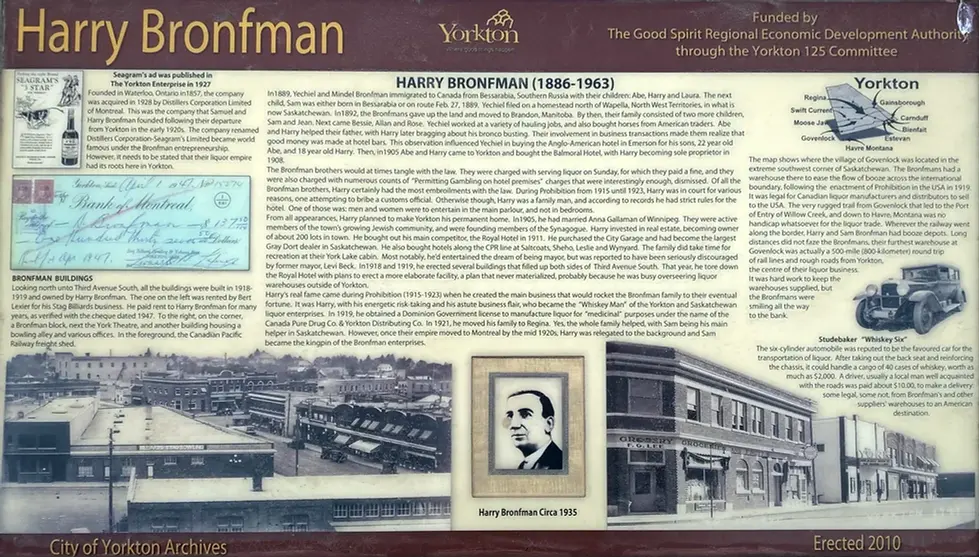
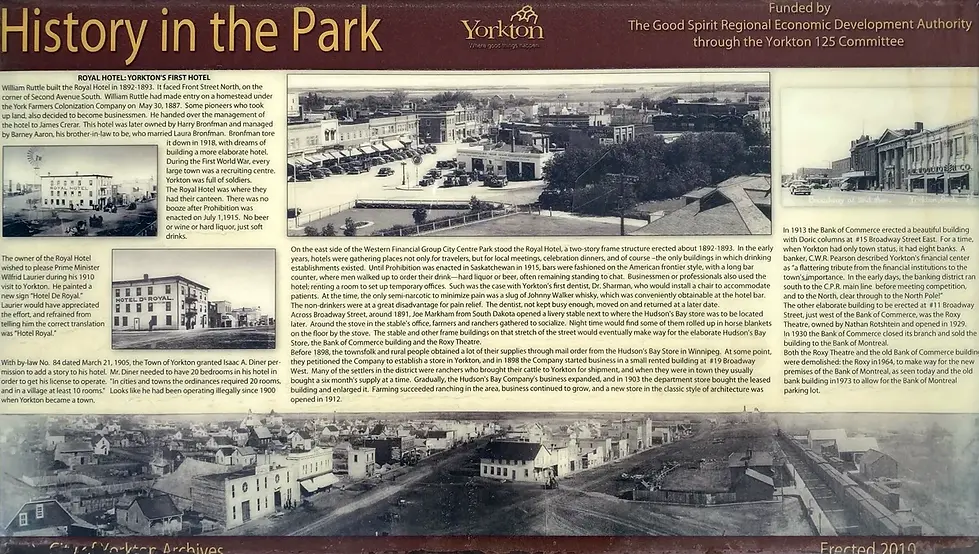
Historical markers tell the stories of the Balmoral Hotel, Harry Bronfman, and the area which is now City Centre Park on the south side of Broadway between Second and Third Avenues.
The historical markers, shown below, are located:
-
On the parking lot of the Cornerstone Credit Union along Livingstone Avenue, former site of the Balmoral Hotel;
-
On the south side of Broadway near the corner of Third Avenue, once part of Harry Bronfman's extensive extensive land and property holdings in Yorkton;
-
In City Centre Park.


1 on the map above
2 on the map above
3 on the map above
The Balmoral Hotel on Livingstone Street was a Yorkton landmark for almost 90 years. It was owned in the early 1900s by Harry Bronfman, whose family later owned the vast Seagram empire founded on the production and sale of liquor. Their booze business started primarily at the Balmoral during prohibition from 1915 to 1924, leading to stories about tunnels, Studebaker Whisky Six cars, a blending and bottling operation housed next to the Balmoral, and much more, as we talked about in the previous podcast.
In 1950, the Balmoral was sold to Emanuel and Marj Balacko and friends from Winnipeg, with the Balackos taking sole ownership a few years later. They owned and operated the hotel until their retirement in 1980, and lived in a suite in the north wing. Their son Ron, a toddler when they took over, grew up in the hotel. We talked to him about his parents, the hotel, and, of course, those tunnels.


Photos in the gallery above: City of Yorkton Archives.
Family photos and photos of hotel artifacts in the gallery below courtesy Ron Balacko.
Advertisement: www.jhcwc.org website of the Jewish Heritage Centre of Western Canada.
The Balmoral Hotel: the Balacko era


A community fridge opened in Yorkton in mid September 2023. It's a place where someone who has no food to eat, and at the time doesn’t have the means to buy it, can go anytime day or night, every day of the year, and find food for themselves and their family.
It's also a place where those who would like to help people who have little or no food can drop off donations of food, also anytime.
It's a mutual aid project operated by a working group of volunteers who want to help solve problems -- in this case food insecurity in the community -- through collective action rather than waiting for someone else to come to the rescue.
Yorkton Community Fridge on Facebook
Yorkton Community Fridge on Instagram
Signup sheet for Yorkton Community Fridge volunteers
Vancouver Community Fridge Project
Community Fridges Toronto


Frequently asked questions

What if...?
The Yorkton Community Fridge working group does not monitor how much or how often people access the Fridge.
It is open for anyone to take what they need, when they need it, 24/7 and hopefully the community will stock the fridge back up when it’s empty.
According to the working group, "If food is being taken out of the fridge regularly, we can be proud that we’re able to support our neighbours in such a meaningful way.
"With that being said, we are hopeful that people accessing the community fridge will only take what they can use, to minimize the amount of food wasted and increase the number of individuals/families being supported."
People are invited to take what they need.
How Can I Volunteer?
The fridge is cleaned and temperatures are checked twice a day every day by cleaning shift volunteers since it was first opened in mid-September.
The link below will take you to the cleaning shift schedule and you can sign up for any time slot that works for you.
Most Yorkton streets are named for people who were part of our story going back to the founding of York Colony in 1882. Mayors, council members (called aldermen until about the 1980s, then councillors), prominent business owners and others who were deemed worthy of the honour have all lent their names to local roads.
But that doesn't account for all streets and avenues, and some have an interesting (and sometimes surprising) history, as we explore in this podcast.
City of Yorkton street map (in PDF format)
Other maps on the City of Yorkton website
Windows On Our History and other books about Yorkton's history
A local podcast is a relatively new thing in Yorkton, and we have been asked why we started this, and how it all works.
During Culture Days 2023 we held a workshop for a handful of people interested in learning more about podcasts. They had ideas, but weren't too sure how to go about getting started. For future reference, this podcasts answers many of the questions they had, and floats an idea that maybe Yorkton Stories can become an umbrella for other local podcasts, allowing those interested in many aspects of Yorkton life to find information in one place.
To the people of Yorkton back in the late 1940s and 50s, a young man who was born and grew up here, Stan Obodiac, was a bit of a puzzle. He was a really good athlete, and a sometime-writer for the Yorkton Enterprise weekly newspaper. He played hockey, baseball, golf, softball, bowling and soccer. He wrote at least 10 books, several of them while living here as a young man, several of his later ones best sellers.
But the local coffee row didn't quite know what to make of him -- did he have a real job? There is much about him worth telling. There are many sides to the man, and to his life.
No Substitute for Victory on the University of Alberta Peel Library website
World ice hockey champions in Paris - Obodiac's account reveals full glory of the 1951 Lethbridge Maple Leafs, by Mike Rowbottom
Yorkton This Week story written by Stan in 1980 about early life and hockey in Yorkton
Canadian Press story published across Canada on his death in 1984.


Anna Gertrude Ingham of Yorkton was the subject of a cable television documentary called The Quiet Rebel in 1993, which told the story of why and how she developed a revolutionary program for teaching grade 1 kids to read.
Why a rebel? Her methods did not always meet with the approval of education authorities, but she persisted because it worked, the kids liked it because it was fun, and the parent had high praise for it because many of their children in grade 1 were reading after only a few months of school.
We talk with Shirley George, her daughter and collaborator. Shirley was involved in producing the book called The Blended Sound-Sight Method of Learning which was published in 1967, and worked with her mother in conducting workshops for teachers in western Canada. We talk about her mother, about the Blended Sound-Sight program which which she herself taught in Edmonton for several decades, and about teaching it to other teachers.
This video about Anna Gertrude Ingham was produced by Deana Armbruster of North Eastern Cablevision in Yorkton in 1993, documenting the reading system for grade 1 students developed by Mrs. Ingham, then a teacher at Simpson School.
Summary of the components of the program
Excerpt from Chapter 1, explaining the motivation behind and purpose of the program
Complete second edition (revised 1969) which is still on the US Department of Education website
Those interested in purchasing the book may contact us here. Please provide your name and contact information, which we will pass on to Shirley George and she will contact you.
The website ClassicalEducationBooks.ca states the following about the book:
The field-tested methods of The Blended Sound-Sight Program of Learning were developed by Anna Ingham and the countless teachers she has trained for nearly 70 years, including her nephew, Dr. James B. Webster, founder of the Structure and Style® method of teaching writing. Birthed in a one-room, multi-age, multi-ability schoolroom, this book shows how teachers can create an environment where students take ownership of their own education and progress individually, while celebrating accomplishments communally.
-
Provides a solid sequential and incremental approach to language skill acquisition
-
Embeds a wide variety of accepted pedagogical skills into every day instruction
-
Provides frequent check points for comprehension and skill mastery
-
Has enough flexibility to allow for various learning styles
-
Can be easily adapted for students with learning challenges and/or language learners


Our years of reading about food from many cultures, collecting recipes from family, from our own time in the food business, and being graciously given recipes by other restauranteurs, allows us to explore some of them in this podcast, and tell you some of the stories behind our favourite foods.
Butterballs/Butter dumplings/Butter kloss



In Yorkton, the job of preserving the local heritage, whether buildings or artifacts or photographs or stories, has generally rested with the municipality. But for more than 10 years it did not have a historian and archivist, and the information and material in its possession is locked up in a basement room of city hall, with little or no public access.
The city currently now fills that job on a part-time basis, thanks to grant money it received to pay for that. But it does raise several questions: what happens when the grant funding runs out? And more importantly, is it the job of the municipality to preserve our history, other than the formal papers that the city is required to keep? Or should that responsibility fall on the community at large, through an organization like a historical society?
Yorkton history books for sale: Several history books have been published by the city over the years, including a comprehensive history from Yorkton's founding (then York Colony) to 2005. They are available on the City of Yorkton website, the Tourism Yorkton website, and in person at Tourism Yorkton and the Western Development Museum Yorkton.
Other information on the City of Yorkton website:
Broadway and Back interactive walking tour of the old town centre
Access to Information request form
Other information available on the Tourism Yorkton website:
Veterans banners, a program of the Royal Canadian Legion General Alexander Ross branch in Yorkton
Yorkton's heritage properties are listed on the Saskatchewan Heritage Property Search website. Each property has an associated PDF file explaining the heritage value, and information from the city bylaw which established it as a heritage property.
29 Myrtle Avenue (original Doukhobour house)
Army Navy and Air Force Veterans building (now retail and offices)
Yorkton Organic Milling Ltd. (now the historic Yorkton flour mill owned by the Yorkton Brick Mill Heritage Society inc.)
MemorySask.ca is the website of the Saskatchewan Archival Information Network, managed by the Saskatchewan Council for Archives and Archivists, with technical support and web hosting by the University of Saskatchewan Library.
MemorySask.ca Howard Jackson photo collection
A search on the home page for "Yorkton" also provides links to other photos and documents about Yorkton which are part of other collections.
Provincial Archives of Saskatchewan Yorkton Oral History Project is a collection of audio interviews with 63 long-term residents of Yorkton and district conducted by Philip Redant and Julie Redant between 1978 and 1991. Those interviewed discuss their family history and describe Yorkton during earlier years.
In 1898, J.J. Smith built a flour mill at the new site of Yorkton, which had moved south a few miles from the original York Colony settlement to be alongside the new rail line. The mill, built of brick where most mills of the era were wooden structures, went from a bustling village hub to a dilapidated eyesore by 2000, suitable only for the wrecker's ball, many thought.
Today, 125 years later, the grounds and building are again a busy place for community activities, with more to come, due to the work of a non-profit historical society and many volunteers.
We trace the up and down and up of the flour mill as we hear from Carman Smith of Barriere, BC, the grandson of the original owner and builder, as well as those involved in saving and restoring the mill in recent years.
Gilbert Smith Forest Products website. This is the company founded by Carmen Smith and his brother, successor to the mill started by his father Gilbert Smith, who left Yorkton as a boy when J.J. Smith moved the family to British Columbia.




Curt Keilback started in radio in Yorkton, following on the heels of his father Jim who moved to Regina to continue an illustrious career that started in Manitoba and continued in Yorkton. After leaving Yorkton, Curt was the broadcast voice on both radio and television for the first edition of the Winnipeg Jets, and the Coyotes of Phoenix, Arizona, calling the play-by-play for 2,400 NHL games.
Now retired and back in Winnipeg, Curt wrote a book about his hockey experiences, short vignettes where he remembers the hockey people and happenings spanning a 17-year career. The book is called Two Minutes for Talking to Myself, and he talked to us about all of that, about his dad Jim, and more.


The Broadway Restaurant in Yorkton, also called the Broadway Café, was a longtime local institution serving Chinese and Canadian food. It was operated in the early days by Joe Mak, an immigrant from China who had come to Canada with his younger brother to work as cooks for the crews expanding the railroad westward. The younger brother had left his wife and three sons in China when he came to Canada. The middle son's name was Lai Foo. Lai Foo never really knew his father, who came home to China but died soon after. But he was a favourite nephew of Joe Mak – Uncle Joe – who would play a major role in his life.
The story of Lai Foo’s early life is told in a book called Life of Lai, written by Carl Mark, the second-oldest son. It recalls his story from the time Lai was 13 years old and entered the military college in Bejing in the pre-communist years, and his rise to being selected for officer training, and becoming an officer in the military police.
But it was wartime and his family, Uncle Joe in Canada in particular, didn’t want Lai involved in war. He arranged for his immigration to Canada, all described in great detail in the book, which ends when Lai arrived in Canada in 1950.
The podcast continues the story from there, when he was no longer Lai Foo, but was known as Bob Mark who, for the next 43 years, operated restaurants in Yorkton and briefly in Hanna, Alberta.
Video story by Kaylyn Whibbs, broadcast by CTV News on Feb. 10, 2021.
Story about the book, by Calvin Daniels, Yorkton This Week, Feb. 19, 2021.


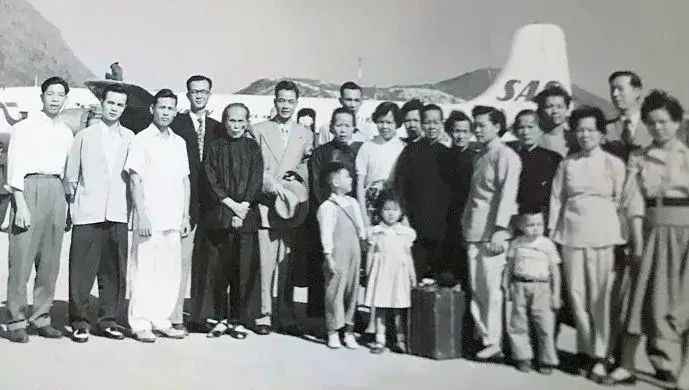
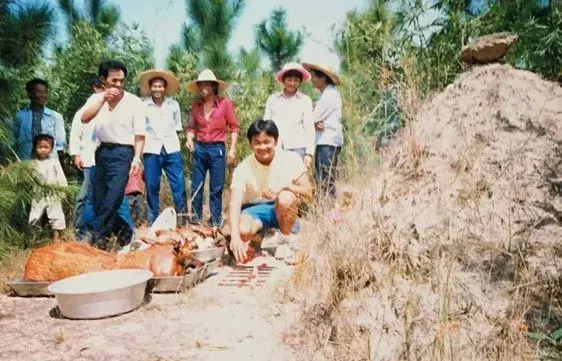


Bill and Joyce Anaka spent part of the summer of 1996 creating an inventory of two dozen cemeteries in the RM of Good Lake, part of a project sponsored that year by the Saskatchewan Genealogical Society.
It was familiar territory for both of them, having grown up near the south end of the lake. Joyce's grandfather first came there in the 1880s because of the good grazing land, and the Gunn family became well-known to the area, including Yorkton, for Gunn's Beach, and later Gunn's store, which provided goods not only for the local rural residents and nearby Indigenous people, but for the many visitors to the lake in summer.
Now 97 years of age, Joyce recalls the summer of searching out cemeteries, some of them abandoned in bushes or plowed over, one of them in a rural road ditch, and creating an inventory of those buried there, at least where the names on headstones were recognizable or obtainable.
She also talks about her family's history on the land that now forms part of Good Spirit Provincial Park. And we talk about the name of the lake. Back in those days, Good Spirit Lake was known locally -- and still is referred to today by many oldtimers -- as Devil's Lake.
Complete record of cemeteries compiled by Joyce and Bill Anaka in 1996 (49 pages)
Other cemetery records and maps of the RM
1920 RM map showing the lake as Devil's Lake
Saskatchewan Genealogical Society website
List of branches of the Saskatchewan Genealogical Society
An Interesting Summer Recording Cemeteries, by Bill and Joyce Anaka, published in the SGS Bulletin, December 1996
Introduction to Trading Post to Provincial Park (Gunn's Beach and Beyond), by Joyce Anaka


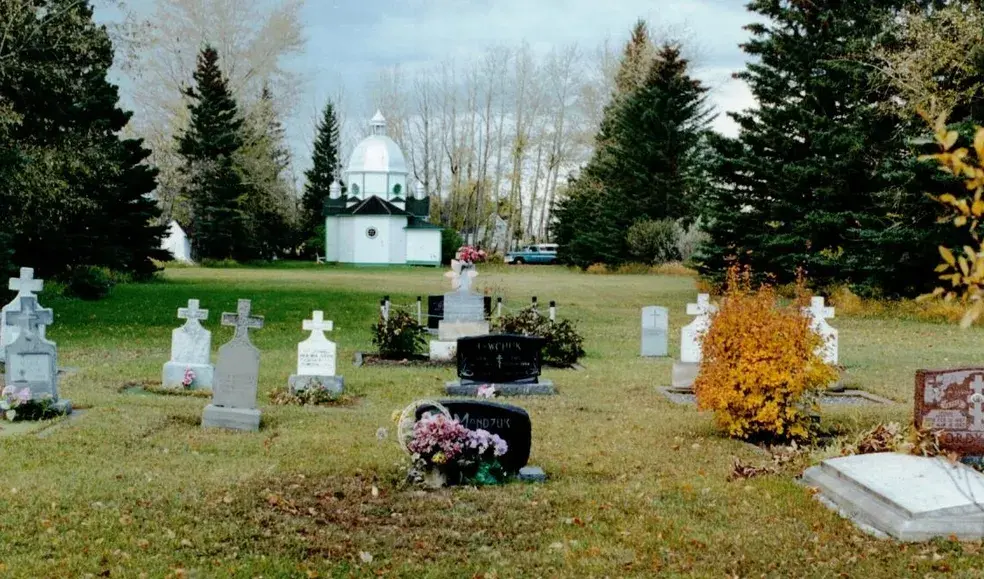
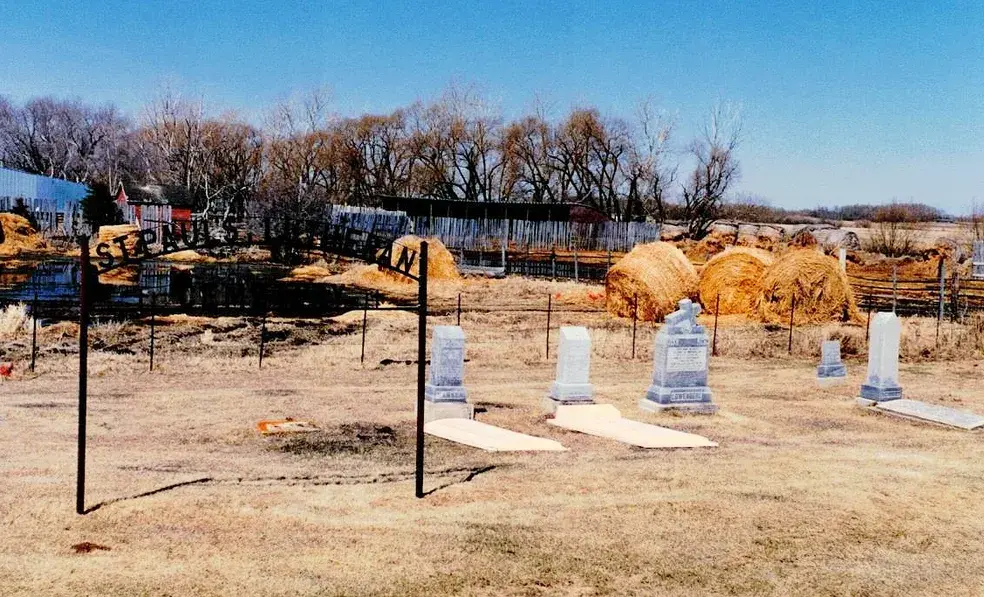


Fifty years ago, Elwyn Vermette with help from a lot of friends built a geodesic dome house just south of Yorkton along Highway 9. About 20 years ago his daughter Tonia, with Elwyn's guidance and assistance, built a monolithic dome house close by.
This is the story of those two projects which resulted in two one-of-a-kind houses that stand alongside a seed potato farm which Elwyn also started.
The geodesic dome house


Comprehensive information about Buckminster Fuller, including his development of geodesic domes, on Wikipedia
The Canadian Dome Industries website.
Country Man by Valdy, on YouTube.


